
Generative AI is transforming the way we think about Artificial Intelligence and human interactions with software. Learn more about ChatGPT, Midjourney and other Generative AI tools and find out how they can help you create value.
All the buzz generated by Chat GPT and DALL-E has brought attention to Generative Artificial Intelligence, or Gen AI. But what is it exactly? Generative AI models fall under the category of Machine Learning and are capable of generating outputs (for example texts, images, videos, audio and code) by making predictions based on input data. Generative AI models use statistical and probabilistic principles to generate new content based on patterns in data. They strive to define the joint probability distribution of the observed data, and sample from this distribution to generate new, plausible data points. To use the words of Gartner, “Complex math and enormous computing power are required to create these trained models, but they are, in essence, prediction algorithms.”
So, what can we actually do with them? As it turns out, a lot.
Real-life applications of Gen AI and most used tools
Gen AI is designed to create content similar to what humans produce. From text to audio, from images to code, these technologies have the potential to drastically improve business efficiency, saving money and time.
Organizations need to be familiar with the current application landscape to move forward with generative AI in business; let’s see in practice some Gen AI uses cases based on the type of output.
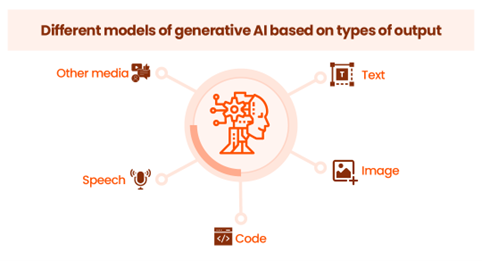
- Text
At the moment, the most famous Generative AI tool is probably ChatGPT. Owned and developed by OpenAI, it was launched in November 2022 and immediately had a huge impact on the public. ChatGPT has an impressive ability to generate human-like text within seconds and for all kinds of purposes: social media posts, blog articles, emails, essays, and even poetry (though it somehow lacks in creativity, but can help us enhance ours).
2. Image
Text-to-image tools are able to generate images given a textual prompt. Midjiourney and DALL-E are among the most popular, and even have a free version that everyone can use and have fun with. Utilizing methods like Generative Adversarial Networks (GANs), Generative AI models can generate unique images or modify existing ones. The range of applications is virtually limitless, and can assist artists in crafting new designs, concepts, or comprehensive graphics.
3. Code
Generative AI tools can automatically write sections of code, speeding up the software development process. There are different possible main applications: code generation, code completion, code review, code refactoring and bug fixing. Many tools are able to generate code, from non-specialised ones like ChatGPT to tools created specifically for this purpose, like Amazon CodeWhisperer, OpenAI Codex e GitHub Copilot.
4. Speech
One of the most impressive breakthroughs in Gen AI is speech-to-text models, which can synthesize human-like speech, create personalized customer experiences and enhance transcription services by converting spoken content into text, extremely useful for many applications like generating written records of meetings, conferences, or customer service calls. Some popular tools include Google Speech-to-Text and Whisper by OpenAI.
How can businesses generate value from Generative AI?
The speed at which Generative AI technology is developing is making it quite difficult for stakeholders to grasp its impact on business and society. However, data are showing big opportunities for companies:
Salesforce’s latest report found out that 86% of IT leaders expect Generative AI to soon play a prominent role in their organizations. IT is not the only sector in which Gen AI is already having a big impact: marketers believe it will transform their roles, with 71% of them expecting Generative AI tools to make them save time and get rid of busy work.
Here are Gartner‘s predictions on the biggest applications of Generative AI models in business:
- Customer experience and retention (the main goal of Gen AI investment according to 38% of executives).
- Revenue growth (priority for 26% of executives).
- Cost optimization (priority for 17% of executives).
- Administration (up to 46% of office and administrative support jobs will be automated.
- Outbound marketing (by 2025, 30% of outbound marketing communications from large organizations will be generated by AI).
What we are seeing is a disruptive technology with the potential to revolutionize not only our way of doing business and art, but also the way we as a society work together with machines; the future will see a massive transformation for businesses able to catch the opportunity.
FAQS on Generative AI
Generative AI is a type of Machine Learning model able to create human-like content based on predictions over data.
There are many popular Generative AI tools and frameworks. Some of the most used are:
Text-to-text: ChatGPT, Bard, Jasper, Hypotenuse AI
Text-to-image: DALL-E, Midjourney, VQGAN+CLIP, Dream by Wombo
Text-to-audio: Lovo.ai, Speechify
Text-to-code: GitHub, Codacy, Hugging Face, TabNine.
Generative AI models are algorithms that can generate new data (such as images, videos, text or other media) based on patterns and features learned from existing data. These models use deep learning techniques such as neural networks, to generate new content similar but different from the input data.
There are many possible applications of Generative AI. According to Google, since Gen AI can process vast amounts of data and answer via text, image or other media, its key applications are customer interaction, insights generation and assistance on repetitive tasks.
Yes, Generative AI can be extremely useful in creative fields, as it can support the creative process, help brainstorm ideas and concepts, explore different styles and generate content (which can be either finalized or need to be modified by humans).
While the potential of Gen AI models are huge, there are risks and ethical concerns that must be taken into consideration. Here are some of the most urgent to address:
While we are prone to think the answers produced by AI are always right, in reality they can be inaccurate, plain false or biased.
A huge risk is associated with the ability of AI to produce deepfakes, i.e. artificial images, videos or audio manipulated using a real person’s face or voice. The results are becoming more and more convincing, and it is getting hard to distinguish deepfakes from reality, with very dangerous implications.
Currently, there is no protection regarding copyright and intellectual property. Gen AI takes and manipulates all kinds of materials taken from the internet without giving it recognition.
Some tools, like ChatGPT, have raised issues regarding privacy, since conversations are stored and all data is processed.
Thanks to its data analysis ability, Generative AI can deliver tailored medications and therapy recommendations to enhance treatment; it can also support specialists in interpreting medical images, and can reduce cost and time spent on hospital administration.
In finance, Generative AI models can reliably analyze numerical data for forecasting and risk assessment, act as personal wealth managers and even transform core processes: Boston Consulting Group predicts that Generative AI may improve the efficiency of specific processes by approximately 10% to 20% in the near future.
Generative AI is limited by the quality of its training data. If the data is inaccurate or biased, the outputs will inevitably be as well. Moreover, while generative AI models can create new content based on existing patterns, they are limited in terms of creativity and originality. In fact, they can only generate new data based on what it has learned from existing data and cannot go beyond that.
Generative AI can be an excellent tool for disruptive and creative innovation in virtually every industry and business department. Companies can leverage its power to brainstorm and create new product and design ideas, support marketing operations, write advertising content, optimize processes and improve customer experience. 5 Critical Hurdles with Innovative Technology Architectures Download the Generative AI POV.
Generative AI is much more than just a technology: it is a revolution bound to change the way our society interacts with machines and manages work. Generative AI models can support key value drivers and improve organizational efficiency. However, there are still entry barriers to adopting such technology in a truly meaningful way. Generative AI development companies and AI consulting companies can offer businesses the support they need to get started with Generative AI and embrace the tech revolution. Contact Tredence to transform your business with the power of industry-focused Generative AI.


